Helius Alternatives in 2026: 8 Solana RPC and gRPC Providers Compared by Workload
Most teams leave Helius over one cost, not the whole product. Compare Triton One, QuickNode, Alchemy, Chainstack, Shyft, RPC Fast, ERPC and NoLimitNodes on pricing model, gRPC access and replay.
On this page +
Helius is a strong Solana platform, and most teams that leave it are not unhappy with the product. They leave because one part of their workload costs more, or is gated higher, than they want: heavy methods billed at 10 credits, streams metered by the megabyte, or gRPC that starts on a $499 plan. This guide compares the main Helius alternatives by the workload you actually run, with prices checked on November 12, 2026.
01The short answer#
- You rely on DAS, webhooks or enhanced transaction parsing: stay on Helius, or look at Triton One, which also sells DAS. Most alternatives are RPC and streaming providers, not NFT and indexing platforms.
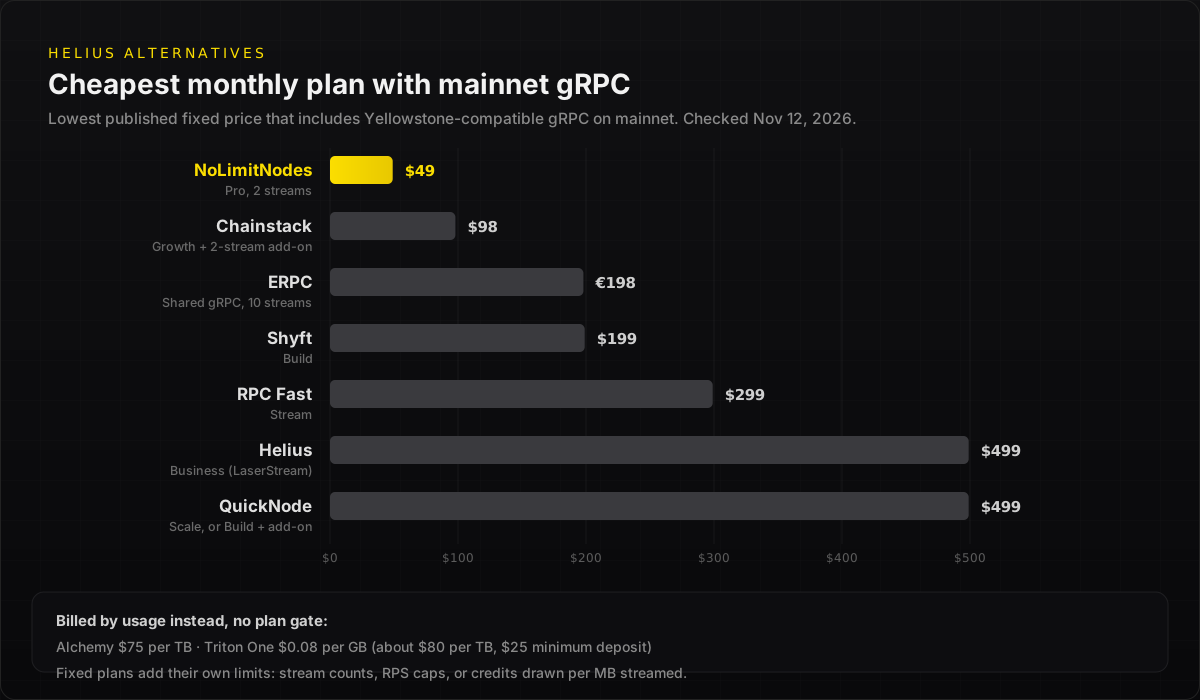
- You want the cheapest mainnet Yellowstone gRPC: flat plans win. Chainstack sells a 2-stream gRPC add-on for $49 on its $49 Growth plan, and NoLimitNodes includes 2 gRPC streams on its $49 Pro plan.
- You stream a lot of data and want to pay per byte: Alchemy ($75 per TB) and Triton One ($0.08 per GB) have no plan gate for gRPC.
- You need replay after a disconnect: Helius keeps about 48 hours, Triton's Fumarole keeps 4 days, and QuickNode replays about 3,000 slots. Check this before you switch, because many alternatives do not publish a replay window at all.
- You run heavy methods like getProgramAccounts: providers that do not weight methods (Chainstack bills 1 request unit per call, flat-plan providers cap by RPS instead) can cost far less than a 10-credit meter.
02What you get on Helius today#
Helius bills in credits. Every plan includes a monthly credit allowance, and paid plans buy extra credits at $5 per million. The Helius pricing page lists these tiers:
The credit weights are where costs diverge from what the plan price suggests. Per the Helius credits docs, a standard RPC call costs 1 credit, but getProgramAccounts and every DAS call cost 10. LaserStream gRPC and all WebSockets cost 2 credits per 0.1 MB of uncompressed data, about 20 credits per MB. Webhook events cost 1 credit each, charged even when delivery fails.
Helius also changed a lot in 2026. On April 7 it moved mainnet LaserStream down from Professional to Business, cut the streaming rate from 30 to 20 credits per MB, and cut its bandwidth add-ons by up to 20%. Standard WebSockets moved onto LaserStream infrastructure, and metering by bandwidth began on May 1, 2026, including for grandfathered plans (Helius announcement). If your WebSocket bill changed in May, that is why.
What Helius does well is real: DAS, webhooks, Sender on every plan, staked connections from Developer, 9 public LaserStream regions and a replay window that, per its replay docs, covers about 48 hours on Business and above. An alternative has to beat it on the parts you use, not on the whole list.
03Why teams look for a Helius alternative#
Public reasons fall into four groups. Most of them come from competitors' migration pages, so read them as positioning, but each one maps to a documented Helius billing rule.
- Streaming is metered by size. At about 20 credits per MB, a broad gRPC or WebSocket subscription burns credits in proportion to chain activity, not to your usage. Chainstack's switch page quotes a customer who moved after the WebSocket pricing change.
- Heavy methods are weighted. A wallet indexer or a bot scanning program accounts pays 10 credits per
getProgramAccountscall. The paginatedgetProgramAccountsV2costs 1 credit, which helps if you can migrate to it. - gRPC starts at $499. Mainnet LaserStream needs Business. That is half what it cost before April, but still ten times a $49 entry plan.
- Shreds and dedicated nodes are separate line items. Raw shreds cost $1,000 per IP per month ($800 on Professional) and dedicated nodes start at $2,900.
One reason that does not hold up: Helius did not drop its top plan to $999 in September 2026, as one price-tracking site claims. That figure appears to confuse a plan price with dedicated-node pricing.
04Helius alternatives compared#
The table compares entry price, pricing model and the two things most teams switch for: gRPC access and replay. Syndica is not listed. Its status page says its Solana RPC and ChainStream APIs were retired in February 2026, although some roundups still recommend it.
| Provider | Entry paid plan | Pricing model | Mainnet gRPC from | Replay window |
|---|---|---|---|---|
 Helius | $49 Developer | Credits; heavy methods weighted | $499 Business | ~48 hours |
 Triton One | Pay as you go ($25 deposit) | $10 per million calls + $0.08/GB | Pay as you go, $0.08/GB | ~1,000 slots; Fumarole 4 days |
 QuickNode | $49 Build | API credits | $499 Scale, or $499 add-on | ~3,000 slots |
 Alchemy | Pay as you go | Compute units | Pay as you go, $75/TB | Not stated |
 Chainstack | $49 Growth | 1 request unit per call | $49 + $49 add-on (2 streams) | Not stated |
 Shyft | $199 Build | RPS-capped, unlimited credits | $199 Build | Not stated |
 RPC Fast | $49 Focus | Compute units | $299 Stream | Not stated |
 ERPC (Validators DAO) | €42 Developer | Tokens | €198 shared gRPC | Not stated |
 NoLimitNodes | $49 Pro | Flat, RPS-capped | $49 Pro (2 streams) | No replay buffer |
05The alternatives, one by one#
Triton One: pay per use, built by the Yellowstone team
Triton built Yellowstone gRPC, so compatibility is not a question. Its pricing page is pay as you go: $10 per million RPC calls plus $0.08 per GB, streaming at $0.08 per GB, and DAS at $50 per million calls plus bandwidth. Features are not gated by plan. Replay on its shared mainnet stream is short, about 1,000 slots, but its Fumarole service keeps 4 days in Amsterdam and New York. Shred streaming costs $900 to $1,500 per IP per month depending on region. Best for: teams that want Helius-grade depth, including DAS, with usage billing instead of credit tiers. For a closer look, see our Triton vs Helius comparison.
QuickNode: the multi-chain option
QuickNode's pricing starts at $49 (Build, 80M credits, 50 RPS). Since June 1, 2026, Yellowstone gRPC is included from the $499 Scale plan and billed against credits by bytes; on Build and Accelerate it is a $499 add-on. Replay with fromSlot covers about 3,000 slots, roughly 20 minutes. DAS is a marketplace add-on at 70 credits per call. Best for: teams that also build on other chains and want one bill. See QuickNode Streams vs NoLimitNodes.
Alchemy: per-terabyte gRPC with no plan gate
Alchemy's Solana gRPC costs $75 per TB with no minimum and no plan prerequisite beyond leaving the free tier. RPC is pay as you go at $0.52 per million compute units, starting at 300 RPS. It lists four regions. It says you can resume from any recent slot but does not state the window. Best for: streaming workloads whose volume you can estimate, where per-TB billing beats a fixed tier.
Chainstack: flat request units and cheap gRPC add-ons
Chainstack charges 1 request unit per call regardless of method (2 for archive calls), which removes the getProgramAccounts penalty entirely. Its pricing page lists Growth at $49 with 20M request units and 250 RPS, and Yellowstone gRPC add-ons at $49 for 2 streams, $149 for 7 and $449 for 25. It also sells an Unlimited Node add-on, priced by RPS, from $149. Best for: method-heavy workloads and small streaming needs on a budget.
Shyft: unlimited credits, gRPC on every paid plan
Shyft's paid plans start at $199 (Build) with unlimited credits, capped by RPS, and include gRPC on every paid tier. It also offers RabbitStream, a shred-derived stream, on paid plans. Its pricing page does not cover DAS, webhooks or regions, so confirm those directly. Best for: teams that want no metering at all and are comfortable starting at $199.
RPC Fast: a ladder of streaming plans
RPC Fast's pricing starts at $49 (Focus, 12M compute units, 50 RPS), with gRPC from the $299 Stream plan and Shredstream gRPC on its top Aperture plan. From Velocity ($399) up, usage is unlimited. Best for: teams that want to step up through streaming capacity with one vendor.
ERPC (Validators DAO): euro pricing and shred forwarding
ERPC's price page lists a €42 Developer plan, shared gRPC from €198 for 10 streams, and direct shreds from €198, with UDP shred forwarding in six regions. Best for: European teams and anyone who wants shreds and gRPC from one low-cost source.
NoLimitNodes: flat plans with gRPC and decoded streams
Our plans are flat: Pro is $49 a month with 200 requests per second, 5 WebSocket connections and 2 Yellowstone gRPC streams with no payload limit. Ultra is $199 with 500 requests per second, 10 gRPC streams and a Shredstream destination. Nothing is metered by credits or bytes; instead, heavy methods have their own per-second caps, listed on our rate limits page (for example, getProgramAccounts at 10 per second on Pro). Plans also include decoded Enhanced and Program Streams.
What we do not do matters too. We do not run a gRPC replay buffer yet, so reconnects need your own backfill, and we do not offer a DAS API or webhooks. If your app depends on those, Helius or Triton is the better fit. Best for: trading bots and indexers that want predictable gRPC cost and decoded program data.
06What streaming costs: a worked example#
Plan prices only tell part of the story for streaming. Here is the monthly cost of a single Yellowstone gRPC subscription that delivers 2 TB, and one that delivers 10 TB, using each provider's published rates. Metering rules differ (Helius counts uncompressed bytes; other providers do not always say), so treat this as an order-of-magnitude guide.
| Provider | 2 TB / month | 10 TB / month | How it is billed |
|---|---|---|---|
| Helius (Business) | $499 | $999 | 2 TB uses 40M of 100M credits; 10 TB uses 200M |
| Alchemy | $150 | $750 | $75 per TB |
| Triton One | $160 | $800 | $0.08 per GB |
| Chainstack (Growth + 2 streams) | $98 | $98 | Priced by stream count |
| NoLimitNodes (Pro) | $49 | $49 | Flat; 2 streams, no payload limit |
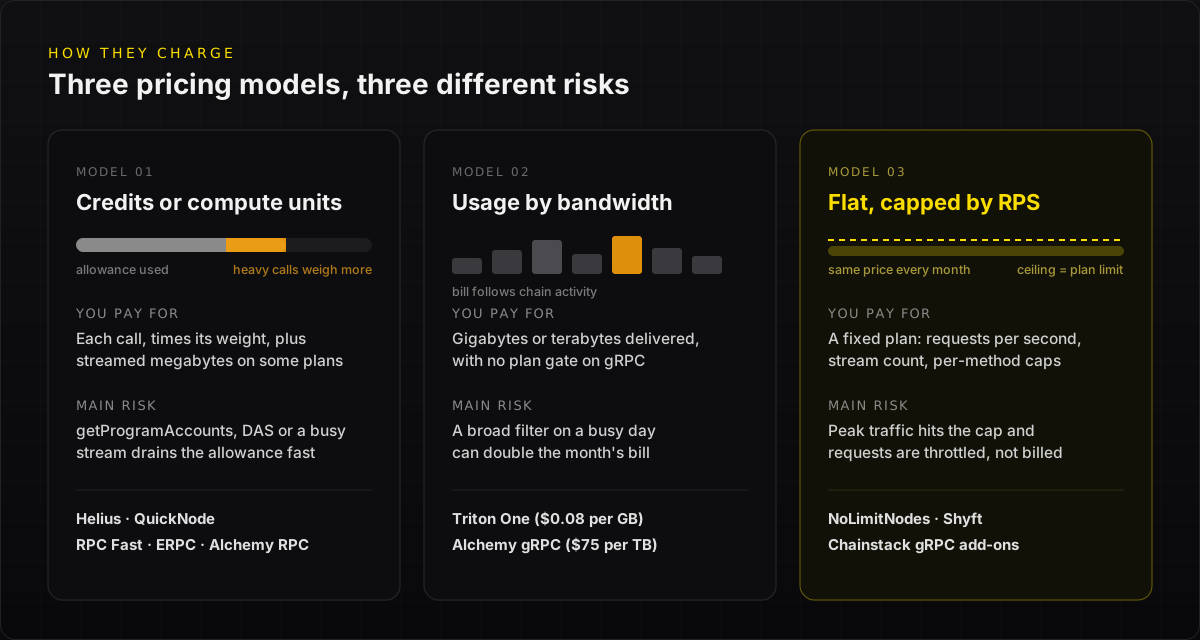
Flat plans are cheapest per byte, but they trade metering for limits: a fixed number of streams and per-method caps. Usage billing scales cleanly and has no plan gate, but a broad filter on a busy day can double a bill. The right choice depends on whether you know your stream volume better than your stream count. Our gRPC API for Solana guide explains how filters drive that volume.
07A migration checklist before you switch#
- List the Helius-only features you use. DAS, webhooks, Enhanced Transactions, Sender and
transactionSubscribehave no drop-in equivalent on most RPC providers. Find a replacement or keep Helius for them. - Measure your real mix. Pull a month of usage by method and stream bandwidth from the Helius dashboard. Price that mix, not the plan sticker, using our RPC sizing guide.
- Check the replay window. If your indexer resumes from a past slot after a disconnect, confirm the new provider's window, or plan a backfill path like the one in our indexer architecture guide.
- Keep your client code. LaserStream is compatible with Yellowstone gRPC, so moving to another Yellowstone endpoint is usually a change of URL and token. Pin client and proto versions your new provider supports.
- Run both in parallel for a week. Compare slot lag, dropped updates and reconnect behavior from the region where your code runs. Our stream provider checklist lists what to measure.
For a broader view beyond Helius alternatives, see our top 10 Solana RPC providers comparison and Yellowstone gRPC vs LaserStream.
08Frequently asked questions#
What is the best Helius alternative?
It depends on what you use. For DAS and Helius-grade depth with usage billing, Triton One. For multi-chain, QuickNode. For cheap Yellowstone gRPC, Chainstack or NoLimitNodes at $49 to $98 a month. For per-terabyte streaming with no plan gate, Alchemy.
Which Helius plan includes mainnet gRPC?
Business, at $499 a month, since April 7, 2026. Before that, mainnet LaserStream required the $999 Professional plan. The $49 Developer plan includes LaserStream on devnet only.
Is LaserStream compatible with Yellowstone gRPC?
Yes. Helius describes LaserStream as a drop-in replacement for Yellowstone (Geyser) gRPC, so moving to another Yellowstone endpoint is usually a change of URL and token, plus pinning client and proto versions the new provider supports.
Which alternative offers the longest replay window?
Triton One's Fumarole keeps about 4 days. Helius itself keeps about 48 hours on Business and above, and QuickNode replays about 3,000 slots. Many other providers do not publish a replay window, and NoLimitNodes does not run a replay buffer yet.
Is Syndica still a Helius alternative?
No. Syndica retired its Solana RPC and ChainStream APIs in February 2026, according to its status page, although some comparison articles still list it.
09Sources#
All prices checked on November 12, 2026. Pricing in this market changes often; confirm with each vendor before you commit.
Every benchmark in this blog runs against our public endpoints.
Spin up an RPC, WebSocket, or gRPC endpoint in under a minute. Flat monthly pricing. Reproduce the numbers for your own workload.