Cheapest Solana RPC Providers in 2026: Real Monthly Cost for Two Workloads, Compared
Sticker prices hide method weights, overage cliffs and separate streaming bills. We priced the same Solana RPC call mix at 10 million and 100 million calls a month across ten providers.
On this page +
The cheapest Solana RPC provider is not the one with the lowest sticker price. It is the one whose billing rules fit your call mix. A $49 plan can cost $49 or $185 for the same 10 million calls, depending on how each provider weights getTransaction or getProgramAccounts. This guide prices two realistic workloads across ten providers, using rates checked on November 12, 2026.
01The short answer#
- Hobby project or prototype: a free tier. Alchemy (30M compute units, 15 RPS), Chainstack (3M request units, 25 RPS) and Helius (1M credits, 10 RPS) are all usable for development. The public mainnet endpoint is free but rate-limited and not meant for production.
- About 10 million calls a month: flat or unweighted plans win. NoLimitNodes Pro and Chainstack Growth both come to $49 for our test mix; dRPC Pro is about the same.
- About 100 million calls a month: flat plans pull far ahead. Most metered providers land between $390 and $1,500 for the same mix (Ankr reaches $5,000); flat and unlimited plans stay between $49 and $399.
- Mostly heavy calls (
getProgramAccounts, transaction history): avoid providers that weight those methods, or check that a flat plan's per-method cap covers your peak.
02Why the sticker price misleads#
Solana RPC providers use five different billing systems, and each one turns the same traffic into a different bill:
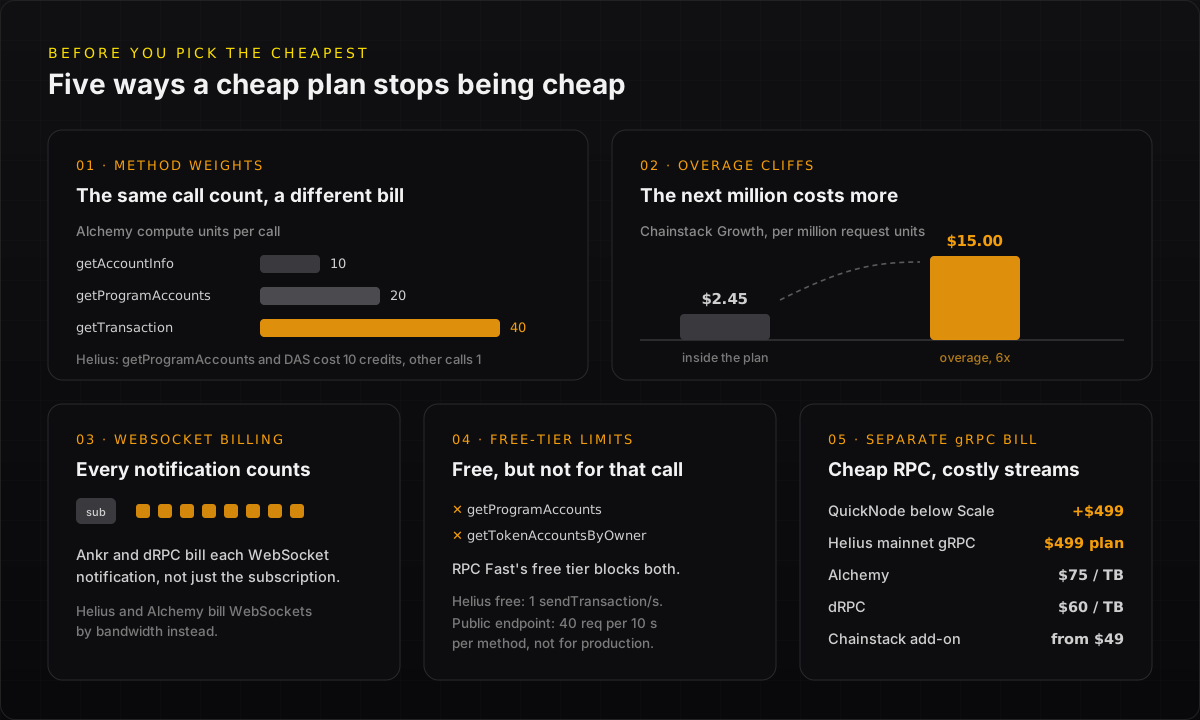
- Credits with method weights (Helius, QuickNode): every call draws credits, and some methods draw more. Helius charges 1 credit for most calls but 10 for
getProgramAccountsand DAS. QuickNode charges 30 credits for every Solana method, so its headline credit allowance buys about 30 times fewer calls than it suggests. - Compute units (Alchemy, RPC Fast): similar to credits. Alchemy charges 10 units for
getAccountInfobut 40 forgetTransaction,getSignaturesForAddressandgetBlock. - Flat request units (Chainstack, dRPC): roughly one unit per call regardless of method. Chainstack charges 2 units for archive calls.
- Per call plus bandwidth (Triton One, Ankr): Triton charges $10 per million calls plus $0.08 per GB. Ankr charges 500 credits, or $0.00005, per Solana call, which is $50 per million despite its $0.10-per-million-credits headline.
- Flat, RPS-capped plans (NoLimitNodes, Shyft, some add-ons): a fixed price buys a request rate, not a request count. You pay the same whether you send one million calls or a hundred million, until you hit the per-second cap.
03Cost per million calls on the cheapest paid plan#
The simplest comparison divides the cheapest paid plan by the calls it includes. This favors light calls; the heavy-call column shows how weights change it.
| Provider and plan | Simple call, per million | Heavy call, per million | Overage |
|---|---|---|---|
 Chainstack Growth ($49) | $2.45 | $4.90 (archive, 2 RU) | $15 per M RU |
 dRPC Pro ($49) | $4.08 | Not published | $3.90 per M Solana requests |
 RPC Fast Focus ($49) | $4.08 | $40.83 (10 CU) | $5 per M CU |
 Helius Developer ($49) | $4.90 | $49.00 (10 credits) | $5 per M credits |
 Alchemy pay as you go | $5.20 (getAccountInfo) | $20.80 (getTransaction) | $0.52 per M CU |
 Triton One pay as you go | ~$10.40 at 5 KB | Higher for large responses | $10 per M + $0.08/GB |
 QuickNode Build ($49) | $18.38 | $18.38 | $0.62 per M credits |
 Ankr pay as you go | $50.00 | $50.00 | $0.10 per M credits |
Flat plans do not fit this table because they sell capacity, not calls. At full use, Shyft Build ($199, 100 RPS) works out to about $0.77 per million, and a NoLimitNodes Pro plan ($49, 200 RPS) to about $0.09. Nobody runs a plan at 100% all month, so the useful question is whether the cap covers your peak, which the next section answers.
04Workload 1: 10 million calls a month#
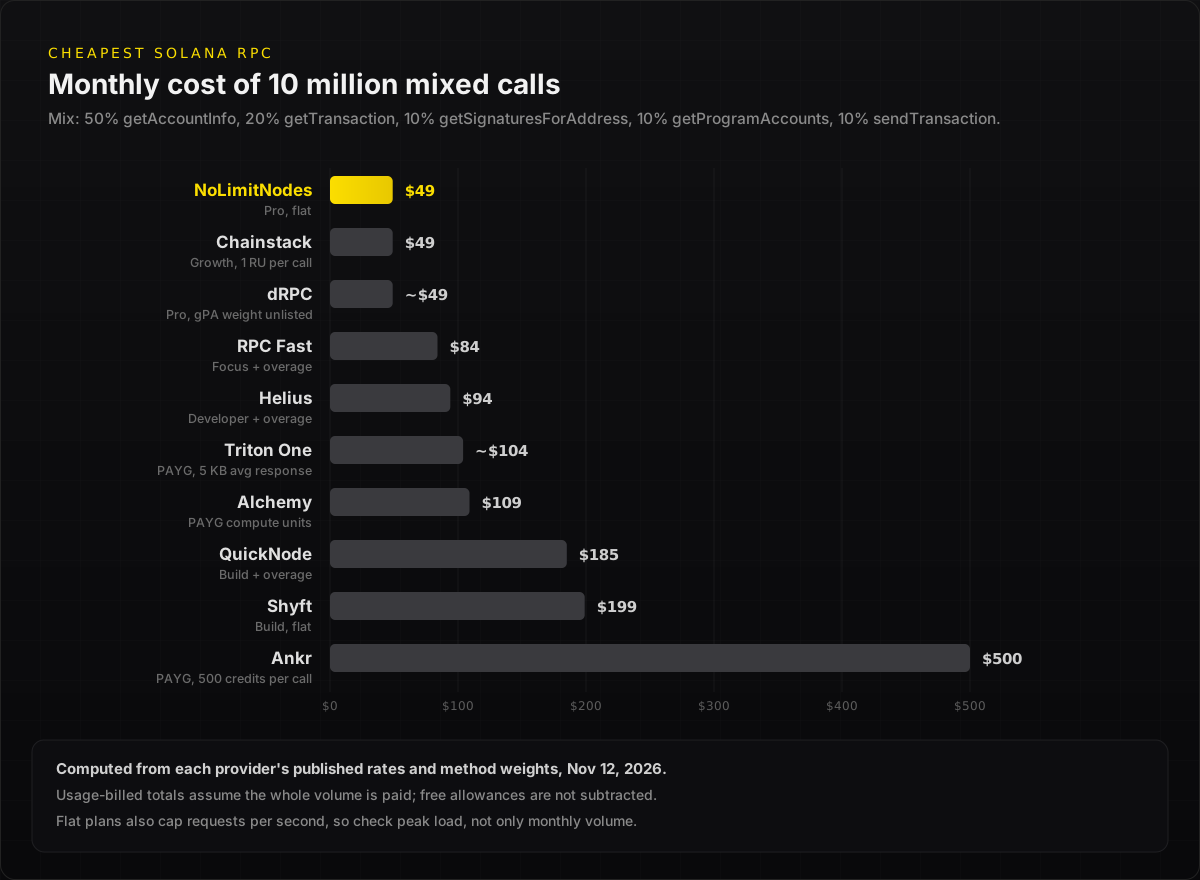
Our test mix reflects a typical trading bot or wallet backend: 50% getAccountInfo, 20% getTransaction, 10% getSignaturesForAddress, 10% getProgramAccounts and 10% sendTransaction. Ten million calls a month averages about 4 requests per second.
| Provider | Monthly cost | Calculation |
|---|---|---|
 NoLimitNodes Pro | $49 | Flat; 4 RPS average is well under 200 RPS |
| Chainstack Growth | $49 | 10M request units, inside the 20M allowance |
| dRPC Pro | ~$49 | Inside the 12M Solana requests the plan lists |
| RPC Fast Focus | $84 | 19M CU: 12M included + 7M × $5 |
| Helius Developer | $94 | 19M credits: 10M included + 9M × $5 |
| Triton One | ~$104 | 10M × $10 per M + 50 GB × $0.08 |
| Alchemy | $109 | 210M CU × $0.52 per M |
| QuickNode Build | $185 | 300M credits: 80M included + 220M × $0.62 per M |
 Shyft Build | $199 | Flat |
| Ankr | $500 | 10M × $50 per M |
05Workload 2: 100 million calls a month#
The same mix at ten times the volume averages about 39 requests per second. This is where billing models separate.
| Provider | Monthly cost | Calculation |
|---|---|---|
| NoLimitNodes Pro | $49 | Flat; 39 RPS average under 200 RPS |
| Shyft Build | $199 | Flat; 39 RPS average under 100 RPS |
| dRPC Scale | ~$390 | $199 for 51M + 49M × $3.90 |
| RPC Fast Velocity | $399 | Unlimited usage at 250 RPS |
| Chainstack Business | $499 | 100M RU inside the 200M allowance |
| Helius Business | $949 | 190M credits: 100M included + 90M × $5 |
| Triton One | ~$1,040 | 100M × $10 per M + 500 GB × $0.08 |
| Alchemy | $1,092 | 2.1B CU × $0.52 per M |
| QuickNode Business | $1,499 | 3B credits: 2B included + 1B × $0.50 per M |
| Ankr | $5,000 | 100M × $50 per M |
For a method-by-method way to estimate your own peak, see how many RPS you actually need.
06Free tiers, and what they leave out#
| Provider | Free allowance | Rate limit | Catch |
|---|---|---|---|
| Alchemy | 30M compute units | 15 RPS | About 1.4M calls for the mix above |
| Ankr | 200M credits | ~30 RPS | About 400,000 Solana calls |
| dRPC | 50M CU | 25 RPS | Public nodes only |
| Chainstack | 3M request units | 25 RPS | Small allowance |
| Helius | 1M credits | 10 RPS | 1 sendTransaction per second, getProgramAccounts 5 per second |
| RPC Fast | 1.5M CU | 15 RPS | No getProgramAccounts or token-account lookups |
| Shyft | Unlimited | 10 RPS | 1 sendTransaction per second, no gRPC |
| Public mainnet endpoint | Unlimited | 100 per 10 s per IP | 40 per 10 s for any one method; not for production |
QuickNode lists 10M credits on its free plan, but at 30 credits per Solana call that is about 333,000 calls, and its own blog describes it as a trial. Two names you may see in older roundups are gone: Syndica retired its Solana RPC in February 2026, and InstantNodes no longer appears to operate.
07Five costs that are not on the pricing card#
- Method weights. The heavy-call column above can be ten times the light one. Price your actual mix, not 1 million
getAccountInfocalls. - Overage cliffs. Chainstack Growth costs $2.45 per million inside the plan and $15 per million beyond it. Moving up a tier is often cheaper than paying overage.
- WebSocket notifications. Ankr and dRPC bill every notification, not just the subscription. Helius and Alchemy bill WebSockets by bandwidth. A busy
programSubscribecan cost more than your RPC calls. - Separate streaming bills. gRPC is a $499 add-on on QuickNode below Scale, needs a $499 plan on Helius, and costs $75 per TB on Alchemy and $60 per TB on dRPC. If you will stream later, price it now. Our Helius alternatives guide compares gRPC entry prices.
- Hard stops. dRPC stops serving at a zero balance, and RPS-capped plans throttle at their ceiling. Neither adds a surprise charge, but both can drop requests at your busiest moment.
08How to find your cheapest provider#
- Export a week of request logs and count calls by method.
- Find your peak requests per second, overall and for
getProgramAccounts,getSignaturesForAddressandsendTransaction. - Price the monthly mix with each provider's weights, using the tables above as a template.
- Check that flat plans' caps cover your peak, and add streaming if you need it.
- Test the two cheapest candidates side by side for latency and errors from the region your code runs in. Cheap is not cheap if your transactions land late; see where RPC latency comes from.
Our pricing page lists every NoLimitNodes plan and limit. For a wider view of features beyond price, see the top 10 Solana RPC providers comparison and our Solana RPC page.
09Frequently asked questions#
What is the cheapest Solana RPC provider?
It depends on your call mix and volume. For our test mix at 10 million calls a month, NoLimitNodes Pro, Chainstack Growth and dRPC Pro all came to about $49. At 100 million calls, flat plans such as NoLimitNodes Pro ($49) and Shyft Build ($199) were cheapest, as long as their per-second caps cover your peak.
Is there a free Solana RPC for production?
Not a reliable one. Free tiers from Alchemy, Chainstack, Helius, dRPC and others are limited to 10 to 30 requests per second and some block heavy methods. The public mainnet endpoint allows 100 requests per 10 seconds per IP and is not meant for production.
Why do two $49 Solana RPC plans cost different amounts?
Because providers weight methods differently. QuickNode charges 30 credits for every Solana call, Alchemy charges four times more for getTransaction than for getAccountInfo, and Helius charges 10 credits for getProgramAccounts. The same traffic draws down each allowance at a different speed.
Does NoLimitNodes have a free tier?
No. NoLimitNodes plans start at $49 a month for Pro, with 200 requests per second and flat pricing. If you only need a free development endpoint, a free tier from another provider is the better fit.
Do WebSockets and gRPC count against my RPC allowance?
On some providers, yes. Helius bills WebSockets and gRPC from the same credit pool by bandwidth, and Ankr and dRPC bill each WebSocket notification. Alchemy, dRPC and Triton bill gRPC separately by data volume. Flat plans usually limit connection and stream counts instead.
10Sources#
All prices checked on November 12, 2026. Some pages were ambiguous: GetBlock's Solana compute-unit multiplier is not published in a readable form, so it is left out of the calculations, and dRPC's docs and pricing page imply different per-call weights. Confirm with each vendor before committing.
Every benchmark in this blog runs against our public endpoints.
Spin up an RPC, WebSocket, or gRPC endpoint in under a minute. Flat monthly pricing. Reproduce the numbers for your own workload.