Jito Shreds Explained: What Solana Shreds Are and Why Traders Want Them
Jito shreds are ordinary Solana shreds with faster delivery. What a shred contains, data vs coding shreds, Turbine vs shred streams, why traders want them first, and what they cannot tell you.
On this page +
Jito shreds are ordinary Solana shreds, the small signed fragments of a block that a slot leader broadcasts, delivered through Jito's ShredStream network instead of only through Solana's normal Turbine propagation. They are not a separate data type. “Jito shreds” describes where the shreds came from, not what they are.
This guide is for developers, searchers and RPC operators who keep hearing “get shreds first” and want to know what that means. It covers what a shred contains, how shreds travel, why trading teams pay for them, and how to receive the same Jito-compatible shreds now that Jito has announced the end of its hosted ShredStream service.
01What is a shred in Solana?#
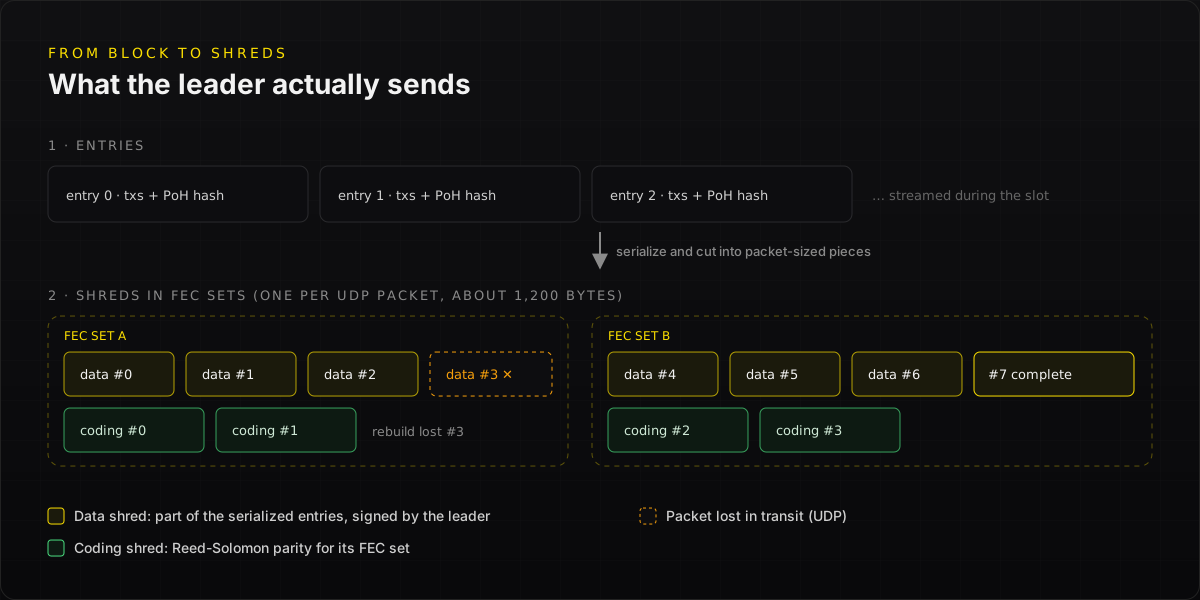
When a validator is the slot leader, it builds its block as a stream of entries. Each entry is a batch of transactions plus a proof-of-history hash. The leader serializes those entries and cuts the bytes into shreds, pieces small enough to fit in a single UDP packet. Each shred is signed by the leader, so receivers can confirm it came from the expected validator.
Every shred carries a small header that tells a receiver where it belongs:
Because a leader streams shreds while it is still producing the block, a receiver can start reading transactions before the block is complete, voted on or replayed by the rest of the network.
02Data shreds vs coding shreds#
Shreds come in two kinds:
- Data shreds carry the serialized entries. Reassembling them in index order gives you the leader's block data.
- Coding shreds carry Reed-Solomon erasure codes computed over a group of data shreds, called an FEC set (forward error correction set). If some data shreds in a set are lost in transit, a receiver with enough coding shreds can rebuild them.
UDP drops packets, so erasure coding is what makes a UDP-based block broadcast reliable. A receiver does not need every packet. It needs enough shreds from each FEC set.
03How shreds travel: Turbine and shred streams#
By default, shreds move through Turbine, Solana's block propagation protocol. The leader sends each shred to a root node, which retransmits it to a layer of validators, who retransmit to the next layer. The tree is weighted by stake, so validators with more stake tend to sit closer to the root and see shreds earlier. Nodes near the leaves, such as an unstaked RPC node, see them later.
A shred stream shortcuts that tree. Instead of waiting for shreds to hop through several Turbine layers, a provider with good network placement forwards shreds straight to your server as soon as it receives them. That is the service Jito ShredStream offered, and the one NoLimitNodes Shredstream offers today. Our Solana Shredstream guide goes deeper into Turbine and the receiver loop.
04What makes Jito shreds different?#
Nothing inside the shred changes. What Jito added was delivery:
- Clients got a Solana public key approved by Jito and ran the open-source jito-shredstream-proxy.
- The proxy authenticated to Jito's Block Engine and received shreds from up to two regions on UDP port 20000 by default.
- It forwarded them to your own
IP:portdestinations, or decoded them and streamed transactions over gRPC.
Jito said this could save “hundreds of milliseconds” during trading, and it gave servers in less-connected regions a redundant shred path. Because so many teams used the proxy, a lot of deshredders and trading stacks were built around the packets it forwarded. A feed that sends packets in the same format can plug into those stacks without code changes.
05Why traders want shreds first#
Shreds are the earliest public signal that the leader has included a transaction. For latency-sensitive teams, that matters:
- Sniper bots see a token creation or first liquidity add while the block is still being produced.
- MEV searchers spot large swaps that will move a pool and react in the next slots.
- Market makers update quotes before processed RPC data shows the trade.
- RPC operators feed shreds into nodes in weaker regions, so those nodes keep up with the chain tip.
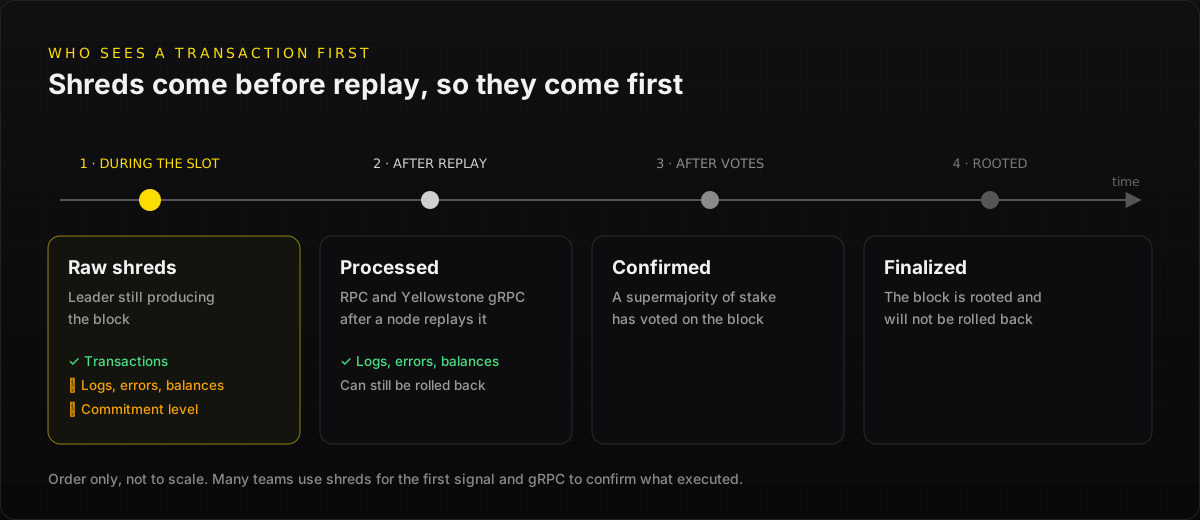
Compare that with the usual paths. Processed or confirmed data from RPC and Yellowstone gRPC is only available after a validator has replayed the transactions. Shreds come before that step.
06What shreds cannot tell you#
Speed has a cost. Raw shreds:
- Have no execution results: no logs, errors, balance changes or compute usage.
- Have no commitment level: a shred's slot can still end up on a minority fork that gets dropped.
- Can be duplicated: you will see the same shred from multiple paths and must deduplicate.
- Arrive out of order: you sort by
slotandindexand wait for FEC sets to complete.
That is why many teams pair two feeds. Shreds give the earliest signal, and gRPC confirms what actually executed. To turn shreds into transactions, see How to Decode Jito Shreds.
07How to get Jito-compatible shreds today#
Jito's documentation announced that ShredStream would be completely shut down on September 5, 2026, and recommended DoubleZero Edge as its migration path. If your stack already decodes the packets Jito's proxy forwarded, the simplest move is a provider that sends the same format.
NoLimitNodes Shredstream sends raw mainnet shreds over UDP, in a format compatible with the Jito proxy and client path, to a public IPv4 address and port you verify in the dashboard. Your existing receiver and deshredder can be reused.
Moving an existing Jito setup is covered step by step in Jito ShredStream Shutdown: How to Migrate.
08Frequently asked questions#
Are Jito shreds different from normal Solana shreds?
No. Jito shreds are standard Solana shreds produced and signed by the slot leader. The difference is delivery: Jito ShredStream forwarded them over a low-latency network to approved clients, instead of clients waiting for Solana’s Turbine tree. The data inside each shred is identical.
How big is a Solana shred?
A shred is sized to fit in one UDP packet under a typical network MTU. Jito’s troubleshooting docs describe incoming shred traffic as many packets of about 1,200 bytes. Each packet holds one shred: a header with the signature, slot, index and FEC set, followed by the payload.
Can I see transactions from shreds before they are confirmed?
Yes. Once you collect a slot’s data shreds in order and deserialize the entries, you can read the transactions before the block is executed or confirmed. Treat them as unconfirmed. The slot can still be skipped or land on a fork, and shreds contain no execution results.
What replaced Jito ShredStream?
Jito recommended DoubleZero Edge in its shutdown notice. Other providers also stream raw shreds. NoLimitNodes Shredstream sends Jito-compatible packets over UDP, so teams can keep their existing receivers and deshredders and only change where packets arrive.
09Get shreds first#
Shreds are the earliest view of what a Solana leader is putting on chain. Jito ShredStream made them easy to get, and the packet format its proxy forwarded is still what many stacks expect.
Start receiving Jito-compatible shreds with NoLimitNodes Shredstream. Ultra includes one destination. See pricing or talk to sales about multi-region setups.
Related reading: Migrate from Jito ShredStream · How to Decode Jito Shreds · Shredstream vs Yellowstone gRPC
10Sources#
Every benchmark in this blog runs against our public endpoints.
Spin up an RPC, WebSocket, or gRPC endpoint in under a minute. Flat monthly pricing. Reproduce the numbers for your own workload.